In
1664 King Louis XIV decided that the King of France needed the proper Palace,
so he decided to convert his father’s hunting lodge of Versailles, a swampy
unimpressive sight, into what turned out to be one of the most impressive Baroque
gardens and palaces of all times. The building began and after many years Versailles
became the King’s permanent home. King Lois also decided, in 1682, that all of
the French nobles had to move to Versailles as well because he wanted to be
surrounded by glory and status. Therefore he also moved his entire government
to Versailles because he deemed it had become a place from which the King could
govern his people. The nobles had to do anything and everything that Lois told
them to, even dressing the King, because all ability to gain favor was in the
hands of the King. The King also wanted the nobles there so he could keep an
eye on them. This was an attempt to avoid another Fronde, the civil war in
which a rebellious faction representing the parliament of Paris opposed the
crown when Lois XIV was very young. This was always something that he was
concerned about happening again, so he took every precaution against it. He
wanted the nobles to understand that they needed to gain favor in his eyes to
get want the wanted, not rebel. The courtiers were so busy trying to please
Louis and out rank one another that they did not have time to go off on their
own lands in the country and being raising armies to usurp the king. They would
do this because they were always trying to stay in the King’s good graces. One
of the things that Versailles did was it opened Louis life up to the nobles;
the nobles would help Louis dress in the morning, they would watch him eat and
compliment him and his power, the nobles would follow him about during the day,
and then help hum undress in the evening.
This meant that if the King didn’t know you, you were no one to be
known. To see and be seen was everything. This was the political point of Versailles.
In
1664 King Louis XIV decided that the King of France needed the proper Palace,
so he decided to convert his father’s hunting lodge of Versailles, a swampy
unimpressive sight, into what turned out to be one of the most impressive Baroque
gardens and palaces of all times. The building began and after many years Versailles
became the King’s permanent home. King Lois also decided, in 1682, that all of
the French nobles had to move to Versailles as well because he wanted to be
surrounded by glory and status. Therefore he also moved his entire government
to Versailles because he deemed it had become a place from which the King could
govern his people. The nobles had to do anything and everything that Lois told
them to, even dressing the King, because all ability to gain favor was in the
hands of the King. The King also wanted the nobles there so he could keep an
eye on them. This was an attempt to avoid another Fronde, the civil war in
which a rebellious faction representing the parliament of Paris opposed the
crown when Lois XIV was very young. This was always something that he was
concerned about happening again, so he took every precaution against it. He
wanted the nobles to understand that they needed to gain favor in his eyes to
get want the wanted, not rebel. The courtiers were so busy trying to please
Louis and out rank one another that they did not have time to go off on their
own lands in the country and being raising armies to usurp the king. They would
do this because they were always trying to stay in the King’s good graces. One
of the things that Versailles did was it opened Louis life up to the nobles;
the nobles would help Louis dress in the morning, they would watch him eat and
compliment him and his power, the nobles would follow him about during the day,
and then help hum undress in the evening.
This meant that if the King didn’t know you, you were no one to be
known. To see and be seen was everything. This was the political point of Versailles.
Versailles
was also used to promote the wonderment of France itself by employing France’s
best artists and putting them on display for all to see: the best painters painted
portraits, the best sculptors worked on some of the grandest fountains in the
world (Apollo Fountain as seen in figure at right).
This was in an effort to be better than Italy which was, and still is,
known for some of the best artists. King Lois XIV wanted to display himself in
this art in the most powerful way to show off his greatness. This was often
done by having himself represented in Greek mythology, depicting him as the Sun
god, Apollo.
The earth revolves around
the sun and France and the rest of Europe revolves around King Louis. The
parties that were thrown in the Versailles gardens were a tremendous circus in
celebration of the king. The parties intended to show the nobility and the rest
of Europe how powerful the King of France was. The parties were intended for
the masses and were meant to impress. This meant that there were fireworks,
rides in gondolas on the canal, balls for three thousand people under the
stars, plays, and ballets.
King Lois XIV wanted to show off what wonderful
artist he had how superior his court and culture were to every other court in
Europe.
Yet another way that Versailles
was used for pageantry of aristocracy was by creating temporary stages and
areas suitable as outdoor theaters for the actual dramas. Both the gardens and
the house were to be open to the public so that they could admire the grandeur
of both Lois and France. To assert his authority and maintain his position he
had to do display his wealth and power and intimidate people into submission.
Versailles
was the great political, social, power center of France. It was the networking
center of France for the government was located there and it was where the best
parties were to be found. It was the Palace that would be known for the rest of
history (proved by this very post).
Sources:
Versailles:
The Dream of a King Parts 1-4
Landscape
Design, A Cultural and Architectural History (Rogers, p168-179)
https://blogger.googleusercontent.com/img/b/R29vZ2xl/AVvXsEjScXQpOb27wvymxw9kRI2E3QKysIWwxt81xyXrOcWyf7zJkJWhIx_ramju_TpSP-GQA9KHfjzurF5UzM-YY0wN8RBOAuqdbzOczUM6RwIQZYRQqLFiKC-TkhJYjiU4X411y00UZ8tTyFsB/s1600/chateau-of-versailles.jpg
http://static.panoramio.com/photos/large/19134717.jpg

 The first appearance of Charles
Bridgeman was in 1709 when his signature appears on a plan for the Blenheim
gardens. Bridgeman was apprenticed to Henry Wise who was appointed the head
gardener at Brompton Park Nursery by Queen Anne. When Wise was assigned Blenheim,
Bridgeman followed and most likely worked as a surveyor/draughtsman and
eventually became responsible for laying out the general lines of the garden.
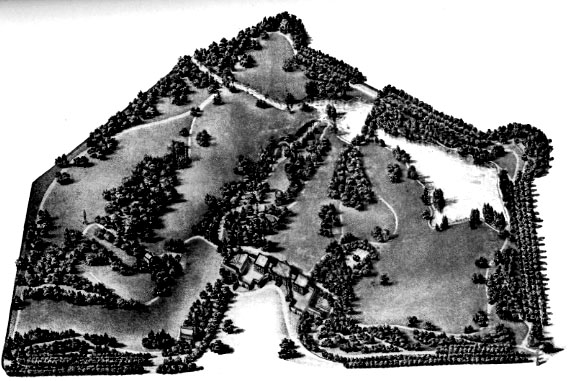
In 1713 Bridgeman began to work on Stowe, and when the garden was enlarged in
1720 he made the Rotunda the focal point, pulling together the scattered parts
of the old garden (see plan in figure).
This lead to the appearance of a deemphasized central axis and made for
a larger focus on the complex walks and vistas that “laced” the garden
together. In 1721 Bridgeman made his plans for Rousham which made apparent his
ability to see the “genius loci” or “the genius of the place” a concept created
by Alex Pope (a poet in the 18th century). In other words Bridgeman
had the ability to see what the landscape could truly look like. Although this
concept can be applied to all of the English Landscape designers, Bridgeman was
one of the first people to embody this idea. Bridgeman embraced the natural
curves, hills, rivers/streams, and roads of the landscape and only improved
upon them. In this way Bridgeman began to free the English landscape from the
ridged geometry inherited from the French Baroque in alignment with the
anti-French sentiment of the time. One of the main themes of the baroque
gardens was rigid enclosure. In an effort to break down those barriers and open
up the garden Bridgeman invented the Ha-Ha, an extraordinary name for a
brilliant invention. The idea was to define the boundaries of the property and
keep out the animals without obstructing the view. Thus began the notion of the
borrowed landscape because the garden and landscape beyond appeared to be one.
(As we will discuss later it was Bridgeman’s successor, Kent, who went beyond
the boundaries of the property and began to tinker with the landscape/view
beyond). Bridgeman was the beginning of the English landscape design he was
really a transitional character for he still had a few straight walkways and
clipped hedges. However, he was still the first to include the wilderness,
fields, and forest.
The first appearance of Charles
Bridgeman was in 1709 when his signature appears on a plan for the Blenheim
gardens. Bridgeman was apprenticed to Henry Wise who was appointed the head
gardener at Brompton Park Nursery by Queen Anne. When Wise was assigned Blenheim,
Bridgeman followed and most likely worked as a surveyor/draughtsman and
eventually became responsible for laying out the general lines of the garden.
In 1713 Bridgeman began to work on Stowe, and when the garden was enlarged in
1720 he made the Rotunda the focal point, pulling together the scattered parts
of the old garden (see plan in figure).
This lead to the appearance of a deemphasized central axis and made for
a larger focus on the complex walks and vistas that “laced” the garden
together. In 1721 Bridgeman made his plans for Rousham which made apparent his
ability to see the “genius loci” or “the genius of the place” a concept created
by Alex Pope (a poet in the 18th century). In other words Bridgeman
had the ability to see what the landscape could truly look like. Although this
concept can be applied to all of the English Landscape designers, Bridgeman was
one of the first people to embody this idea. Bridgeman embraced the natural
curves, hills, rivers/streams, and roads of the landscape and only improved
upon them. In this way Bridgeman began to free the English landscape from the
ridged geometry inherited from the French Baroque in alignment with the
anti-French sentiment of the time. One of the main themes of the baroque
gardens was rigid enclosure. In an effort to break down those barriers and open
up the garden Bridgeman invented the Ha-Ha, an extraordinary name for a
brilliant invention. The idea was to define the boundaries of the property and
keep out the animals without obstructing the view. Thus began the notion of the
borrowed landscape because the garden and landscape beyond appeared to be one.
(As we will discuss later it was Bridgeman’s successor, Kent, who went beyond
the boundaries of the property and began to tinker with the landscape/view
beyond). Bridgeman was the beginning of the English landscape design he was
really a transitional character for he still had a few straight walkways and
clipped hedges. However, he was still the first to include the wilderness,
fields, and forest.


_Brown_by_Nathaniel_Dance,_(later_Sir_Nathaniel_Dance-Holland,_Bt)_cropped.jpg)